Over the last fifty, the Japanese film media had been portraying the family life in a different sense with each new decade; this portrayal of the family had major changes within the role of the parents and those who take on the role of a parent. These themes of change in roles are visual in Barefoot Gen, Tokyo Story, Cruel Story of Youth, and The Family Game. The parents had a variety of different roles throughout the years. The roles that they had portrayed are strong individuals who stood by their ideas, controlled by someone other than themselves, non-authoritative and passive, some were not
involved with their children, and the siblings that took on the role as a parent.

The person that possessed the traits of being strong to themselves and their ideals was the father, Daikichi, from Barefoot Gen. Although Barefoot Gen was written in 1972 for the weekly manga magazine, Shukan Shonen Jumpu, the story of Barefoot Gen takes place days before the Hiroshima bombing in Japan 1945 (Barefoot Gen Vol. 1, Preface 1). Only Gen’s father was a strong individual who was against the war and propaganda used by the government. Daikichi displayed a great sense of character as he taught his children not to go along with what is considered the mainstream thing to do and go by your personal morals. For example, Daikichi had taught Gen and Shinji not to make fun of Mr. Pak for being Korean (Barefoot Gen Vol. 1, 73). Unlike other Japanese people, he believed that the Japanese were not the superior race and instead of making fun of other races, Japan needed the help of the
 Korean and Chinese people in order to win the war (Barefoot Gen Vol. 1, 74).
One of the differences between Barefoot Gen and Tokyo Story would be how the parents were represented. Both take place near the same time frame; Tokyo Story was released in the year 1953, just eight years after Barefoot Gen was based. However, the attitudes of the parents are very opposite from one another. Barefoot Gen had presented a strong forced father while both parents in Tokyo Story were non-authoritative. The father, Hirayama Shūkichi, often went out to drink when his children were still living at his house, as we had learned from the film (Tokyo Story). His wife, Hirayama Tomi, was a passive mother. She had passed all her motherly duties onto her eldest daughter, Shige.
Another parent that possessed the learned characteristic of being passive is Makoto’s father from Cruel Story of Youth. Makoto’s father, Masahiro, was not in control of Makoto nor did he try to truly control her rebellious stage of her life. He admits to Makoto’s sister, Yuki, that he was much tougher on Yuki than Makoto when Yuki was her age. He acknowledges this fact; however, he does nothing to change it. Masahiro blames his lack of authority over Makoto on the “changing times” (Cruel Story of Youth).

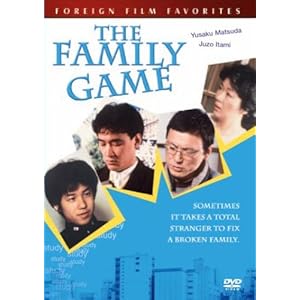
Like Makoto from the film Cruel Story of Youth, the father from The Family Game was also unable to relate to his children. The father, Mr. Numata, was described as “a salaryman jerk, unable to relate to anyone” (Mizenko, Information Sheet.) Mr. Numata had proven this by he had acted towards the wife and children. As Vinh Ly had pointed out on the forums, the father had little to no interaction with his children, except at the dinner table (Vinh, proboards forum, Family Game). He wants his children to go to the best schools, regardless of what they want. However, he is not present for the children’s education nor does he want to get directly involved in it.
Since Mr. Numata does not want to be directly part of the Shigeyuki or Shinichi’s education, other than
 hiring a tutor, Mrs. Numata was a stay at home mother whose responsibilities included doing her motherly duties and making sure that her sons were benefitting from the tutor. Her motherly duties included making food and drinks for the family and tutor and tend to her children. She is expected to drop anything he is doing to take care of her children. For example, when Shigeyuki came home from school nagging the mother lay out his tatami mat for him. When she did not do it immediately, he began to undress down to his underwear in front of the neighbor. In way, she was like Kimie from Barefoot Gen, controlled by her children and husband. She also acted as the medium between the father and sons as Vinh had also pointed out (Vinh Ly, proboards forum, Family Game).
Most of the parents that were presented in the films had negative characteristics in their role as a parent. Sometimes one of the other siblings would take on the role of the parental guide. The three main siblings that took on this feat were Eiko from Barefoot Gen, Shige from Tokyo Story, and Yuki from Cruel Story of Youth. Eiko acted as a mother figure to Gen and Shinji, reminding them that their unborn baby sister needs the sweet potato in order to be born in good health. She was the one who reminded Kimie that she needs to eat the sweet potato in order to assure that the baby had enough nutrition to be healthy (Barefoot Gen Vol. 1, 16).
 from her parents. She had the stress of being motherly to her brothers and sister. She continued being the mother figure for them even past Tomi’s funeral. Shige was the one that had set the funeral plans and reminded her one brother to bring his funeral suit, like a mother would tell her son (Tokyo Story).
As the decades pass by, the roles of the parents change and the eldest daughters were taking on the roles of being mothers to their siblings. In 1945 in which Barefoot Gen was based, the father was presented as a strong individual who stood for his ideals and the mother had the force of her children controlling herself. However, in Tokyo Story which was released in 1953, the parents were depicted as non-authoritative. (Mizenko, Information Sheet). Seven years later in 1960, the father in Cruel Story of Youth was also displays the passiveness that the parents had in Tokyo Story. In Family Game, the father was presented as a man who hardly was around for his Shigeyuki and Shinichi. He also hardly got involved with them and their studies. His wife was perceived as someone whose purpose is to take care of the children. Even the eldest daughters were taking on the roles of their mothers. The daughters were Eiko from Barefoot Gen, Shige from Tokyo Story, and Yuki from Cruel Story of Youth. Eiko had reminded Gen, Shinji, and Kimie that the baby, Tomoko, needs the sweet potato in order to be healthy. Shige had taken the mother role since she was a teenager. She had made sure to remind her brother to bring his funeral suit when Tomi was dying. Yuki was also like a mother to Makoto in her attempts to protect Makoto from the mistakes she made when she was Makoto’s age.